
Vestibule Figure I
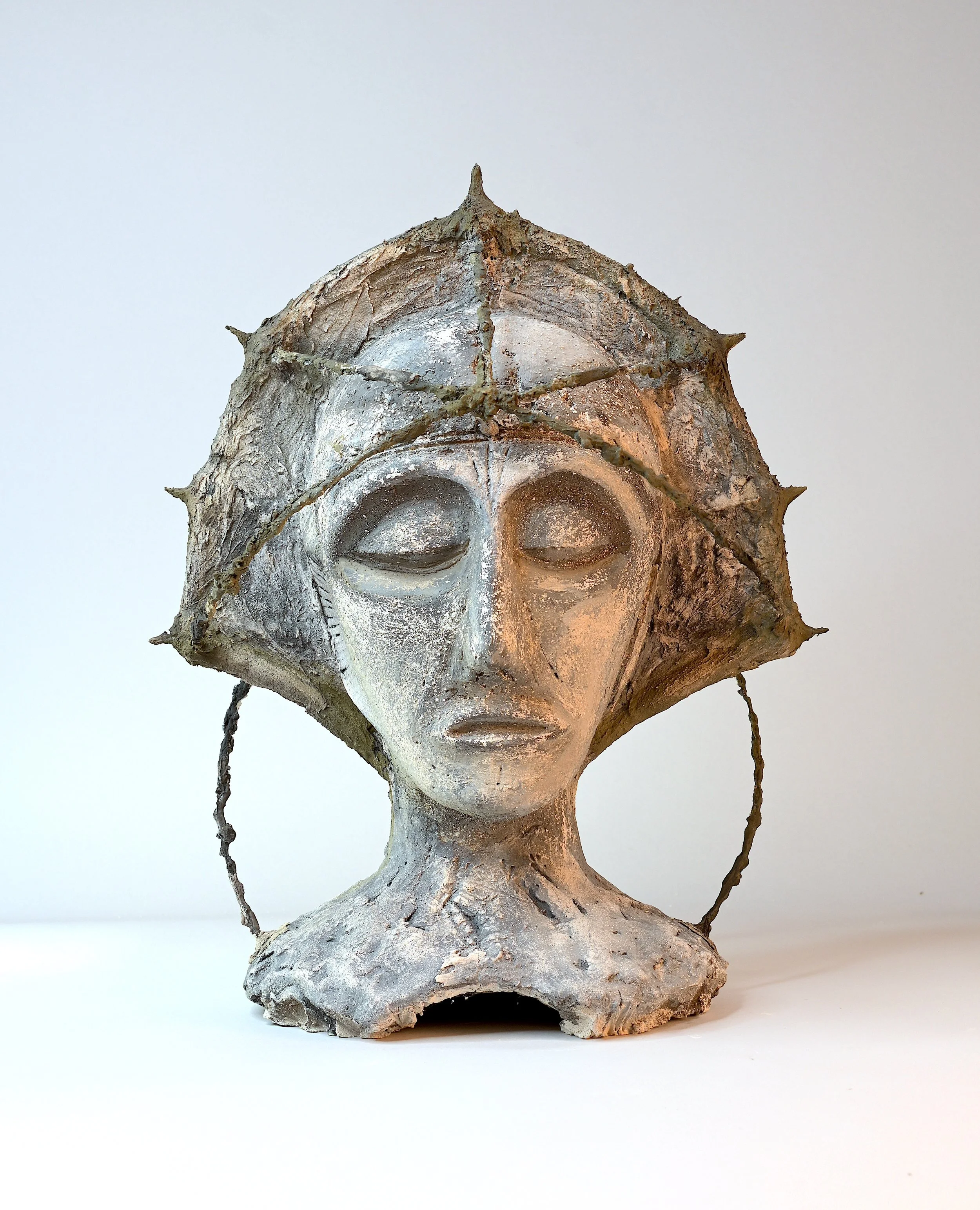
Stoneware clay, Kanthal A1 wire, linen gauze, clay slip, h. 561mm
The beginning of a lineage. A figure suspended between construction and sentience.
.
Reflection
The first appearance of a speculative figure: neither fully formed nor fully known. Constructed from clay, wire and gauze, the work occupies a threshold between emergence and restraint, where identity remains unresolved and perception precedes definition. »»
-
Vestibule Figure I marks the beginning of a lineage that later evolved into the Sentinel Head, Witness and Listener sculptures. The work is concerned not with artificial intelligence as technology, but with the possibility of presence emerging through material form. It occupies an uncertain territory between construction and sentience, between object and presence, where becoming remains incomplete.
The head is enclosed within a fragile armature of wire and gauze that functions simultaneously as framework, cage and coordinate system. These intersecting lines describe a space of measurement and restraint, yet they also suggest the possibility of growth. The structure appears unfinished, as though the figure is still arriving into its own existence.
Incised marks, stitched traces and symbolic forms run across the surface. They do not resolve into a readable language but operate more like fragments of memory or remnants of a lost notation. The figure appears to carry a history that cannot be fully recovered.
The closed eyes and sealed mouth suggest not silence but inward attention. The figure occupies a vestibule between listening and speaking, formation and dissolution. In retrospect, the work can be seen as an early exploration of a question that continues throughout this practice: whether an impression of awareness might arise not as a property of the thing itself, but as a condition held in relation.
Sentient Head II
Stoneware clay, Kanthal A1 wire, linen gauze, clay slip, h. 498mm
A quiet architecture of awareness, poised between emergence and repose.
Reflection
Poised between awareness and sleep, this early head explores the possibility of inward attention. Neither portrait nor symbol, it occupies a threshold between presence and withdrawal. The work marks an early stage in a continuing enquiry into consciousness, perception, and the emergence of percieved presence. »»
-
Sentient Head II belongs to an early group of sculptures that explored how material form might evoke an impression of awareness. Constructed from stoneware clay, wire, linen gauze and clay slip, the work emerged through a process of building, covering, eroding and revealing, allowing the surface to retain traces of its own making.
The head is enclosed within a skeletal framework of gauze and wire, simplified from its precursor Sentient Head I. This structure functions neither as decoration nor as support but as a provisional architecture around the figure. It suggests containment, protection, measurement and transformation simultaneously, as though the work occupies an intermediate state between construction and completion.
The closed eyes direct attention inward. Rather than depicting sleep, they suggest a condition of listening or reflection. The face remains deliberately simplified, resisting individual identity and allowing the sculpture to operate less as a portrait than as a presence.
Although made before the development of the Witness and Listener series, many of the concerns that later became central to those works are already present here: inwardness, attentiveness, ambiguity and the possibility that awareness may emerge through the encounter between observer and form. In this sense, Sentient Head II represents an important stage in the evolution of the broader enquiry that later became Intersentient States.
Silent Custodian I
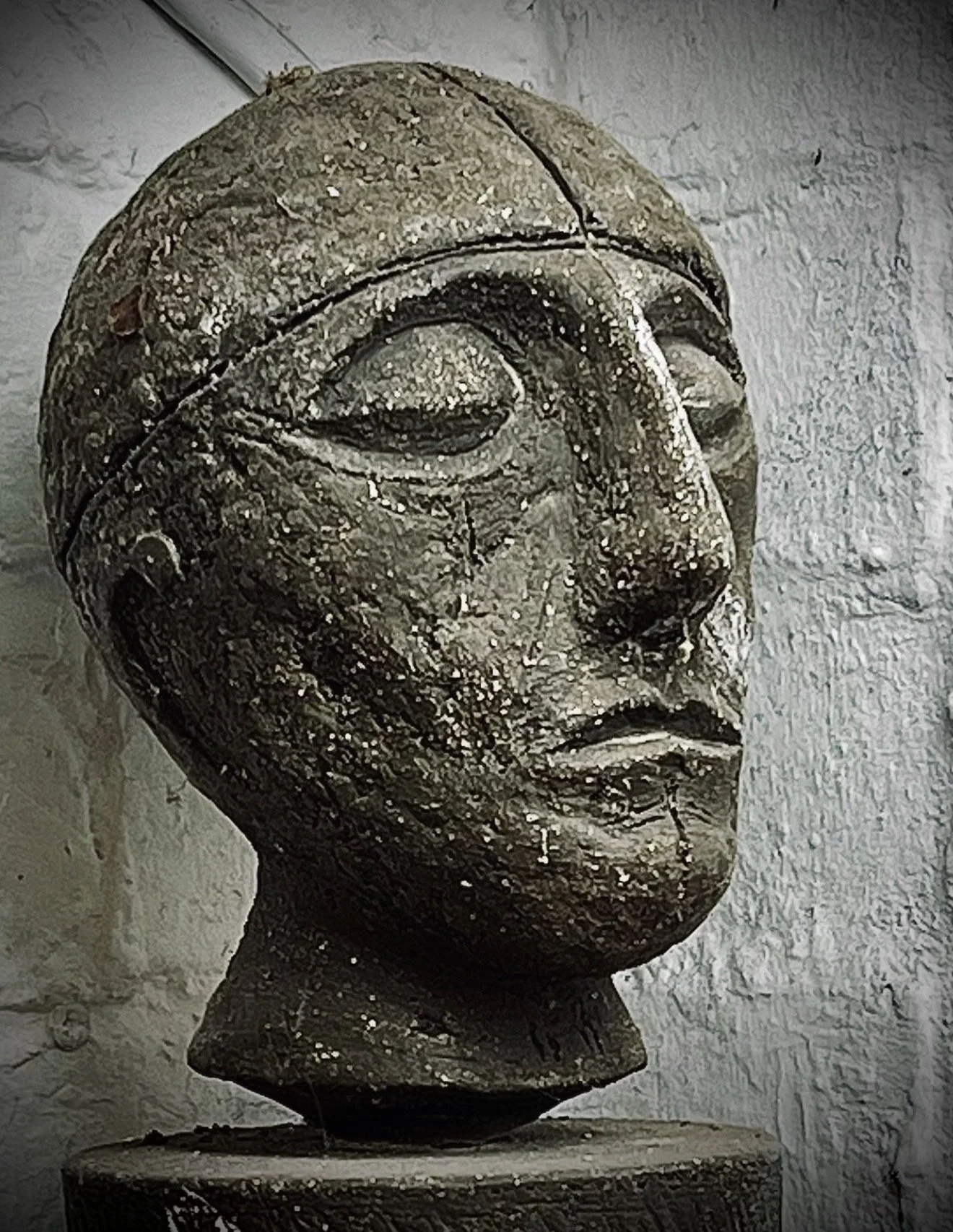
Stoneware clay, slip, h. 340mm
Neither portrait nor monument. A head held in stillness, carrying the quiet weight of memory, endurance, and watchfulness.
Reflection
Silent Custodian emerged from an ongoing interest in how a sculpted head can establish presence without narrative or display. Built through repeated adjustment and refinement, the work retains the traces of its own making within a dense, weathered surface. The closed eyes and restrained modelling redirect attention away from expression and toward duration, inviting a slower encounter. Rather than depicting a particular individual, the sculpture functions as a vessel of retention — concerned less with declaration than with holding. »»
-
Silent Custodian belongs to a broader enquiry into how sculptural form can sustain attention through restraint rather than assertion. Encountered in the round, the head neither confronts nor withdraws. Its closed eyes, compressed surface, and simplified features establish a condition of quiet containment that resists immediate interpretation.
The sculpture developed through an extended process of modelling, abrasion, compression, and revision. Rather than concealing these interventions, the surface preserves them. Cuts, scars, deposits of slip, and areas of erosion remain visible, allowing the material to retain a record of its own formation. What emerges is not a polished image but a form carrying the accumulated residue of decisions made over time.
Although the work suggests the human figure, it avoids portraiture. Identity remains deliberately unresolved. The head functions less as a depiction of a person than as a locus of attention: self-contained, inwardly directed, and resistant to narrative explanation. Its stillness encourages prolonged looking, allowing meaning to emerge gradually rather than through immediate recognition.
The title implies a figure entrusted with keeping rather than declaring. The custodian does not act, persuade, or perform. It simply remains. In this sense the sculpture stands closer to a vessel than a portrait. Its significance lies not in what it communicates but in what it appears to hold.
Within the framework of Intersentient States, Silent Custodian explores how perceptual reciprocity may arise through restraint. Attention is not demanded by the work but generated through its refusal to resolve itself quickly. The encounter unfolds slowly, suspended between material presence, memory, and duration.

Fallen Sentinel I
Stoneware clay, clay slip, h. 362mm
Resting between vigilance and repose. Presence held beyond its appointed place...
Reflection
Fallen Sentinel I explores the expressive possibilities of a head removed from its expected orientation. Resting on its side, the work abandons the authority of upright display and assumes a more vulnerable condition. Despite this displacement, the form retains a quiet gravity, suggesting a presence that persists through fracture, erosion, and time. »»
-
Fallen Sentinel I emerged from an ongoing exploration of the sculpted head as a carrier of presence rather than portraiture. Unlike many of the standing heads within this body of work, the sculpture is deliberately positioned on its side, disrupting expectations of stability, authority, and direct encounter.
This altered orientation changes the relationship between viewer and object. The head no longer occupies the role of observer or sentinel in the conventional sense. Instead it appears suspended between rest and vigilance, decline and endurance. Its lowered position introduces vulnerability without surrendering presence.
The surface contributes significantly to this condition. Layers of clay slip, abrasion, and firing have produced a weathered skin marked by deposits, fractures, and granular textures. These traces are not decorative effects but records of the material processes through which the work evolved. The head appears shaped as much by time as by making.
The sealed eyes and softened mouth resist narrative interpretation. The sculpture does not describe an individual or a specific event. Rather, it evokes a condition of persistence: a form altered by circumstance yet retaining its essential coherence. What remains is neither ruin nor relic, but a continuing presence.
Within the broader framework of Intersentient States, Fallen Sentinel I explores how attentiveness may survive displacement. The work invites prolonged looking not through assertion but through quiet endurance. Its significance lies less in what has happened to it than in what remains.