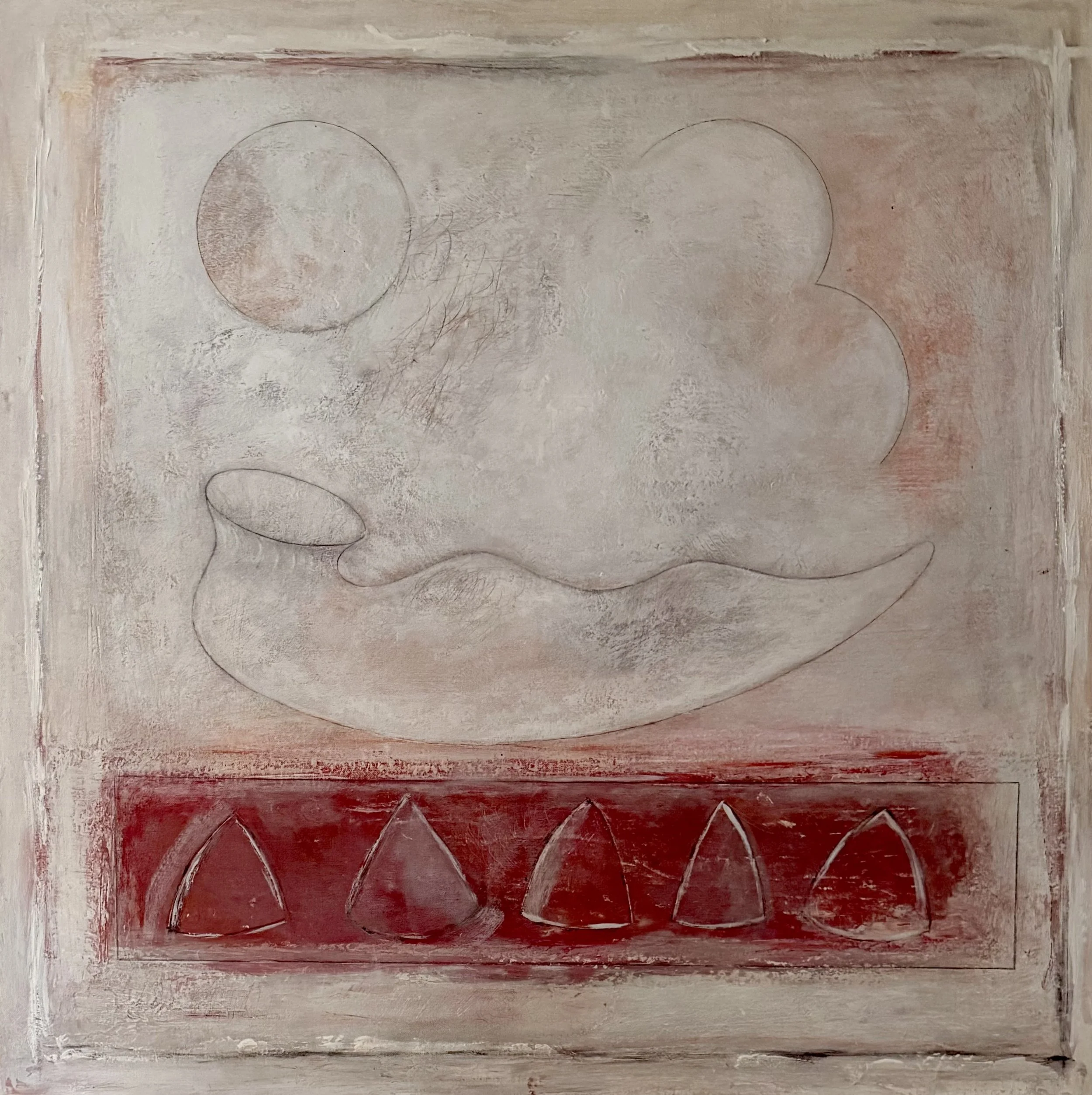
Stone Offering
Acrylic on canvass, 1000mm x 1000mm
A quiet geometry of memory and gesture; a fragment of time, held still in form.
Reflection
This painting draws on both architectural memory and symbolic form. Its imagery emerged from a dialogue between a vessel form that recurs throughout my practice and memories of the early Saxon church at Deerhurst. What appears initially as a simple arrangement of forms carries a longer lineage of objects, places, and associations accumulated over time. »»
-
Near the top of the composition, a round disc hovers like a moon, watched over by a cloud-like form, perhaps even remnants of a torso, that shifts between sky and spirit.Below lies a field of deep red — an altar, a plinth, perhaps a table for rites — cut with five curved triangular forms. They echo the small Saxon niche in St Mary’s Church at Deerhurst, near Tewkesbury: early Christian in origin, their rhythm has become devotional here, almost musical. They mark a threshold — a memory held in stone.
The vessel also appears in a separate sculptural work, weathered and scored with time, but in this painting it becomes still — spectral, suspended in a field of lime and silence. These forms speak of sanctuaries and of a language older than words. The composition is stripped and contemplative, inviting reflection rather than narrative description.
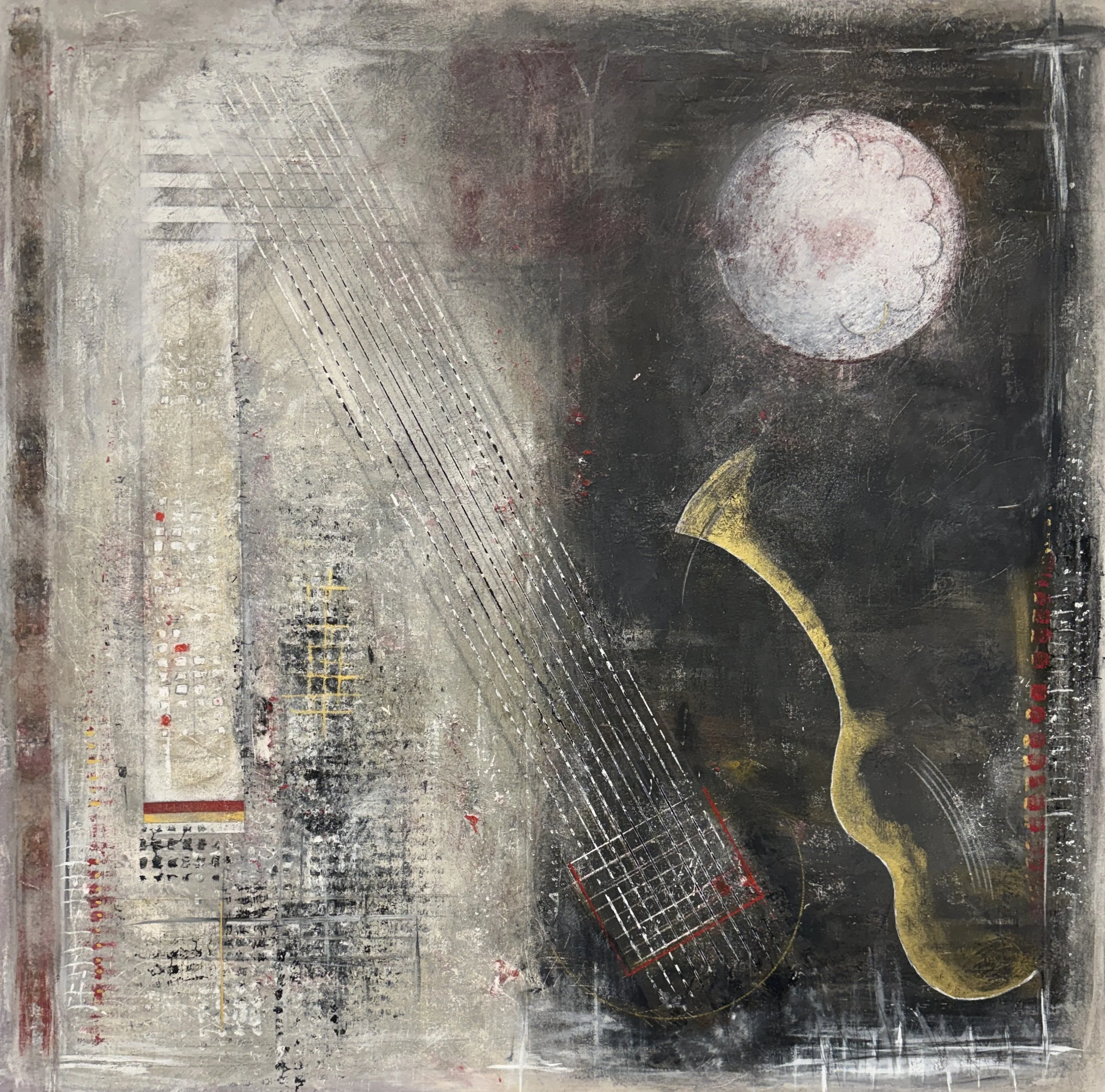
Emergent Polarity
Acrylic on canvass, 1000mm x 1000mm
An accumulated field in which structure and intuition remain in quiet tension.
Reflection
This work emerged through a prolonged process of accumulation, revision, and erasure. Geometric structures, traces of measurement, and more intuitive forms coexist without resolution, creating a field in which attention moves between order and ambiguity. Its meaning lies less in depiction than in the relationships that gradually emerge between its elements. »»
-
Emergent Polarity developed slowly over many months. Marks were repeatedly added, adjusted, obscured, and reintroduced, leaving the surface as a record of accumulated decisions rather than a predetermined image. The painting belongs to a wider strand of work in which structure and intuition are held in deliberate tension.On the left, linear grids, measured intervals, and architectural traces recall systems of organisation, notation, or construction. Opposing these are more fluid forms: a pale circular disc, a curved golden profile, and shifting atmospheric passages that resist fixed interpretation. Neither side dominates. Instead, the work sustains a dialogue between certainty and uncertainty, measurement and intuition, analysis and sensation.
The title refers not to opposites in conflict but to conditions held in relation. The painting seeks a point of balance in which different visual registers can coexist without being resolved into a single reading. Meaning emerges gradually through the intervals between forms rather than through any individual element.
Within the broader context of Intersentient States, I think of the painting less as an image to be decoded than as a perceptual field that unfolds through sustained attention. What matters is not the identification of symbols but the experience of moving between them — a slow process of looking in which relationships become apparent over time.
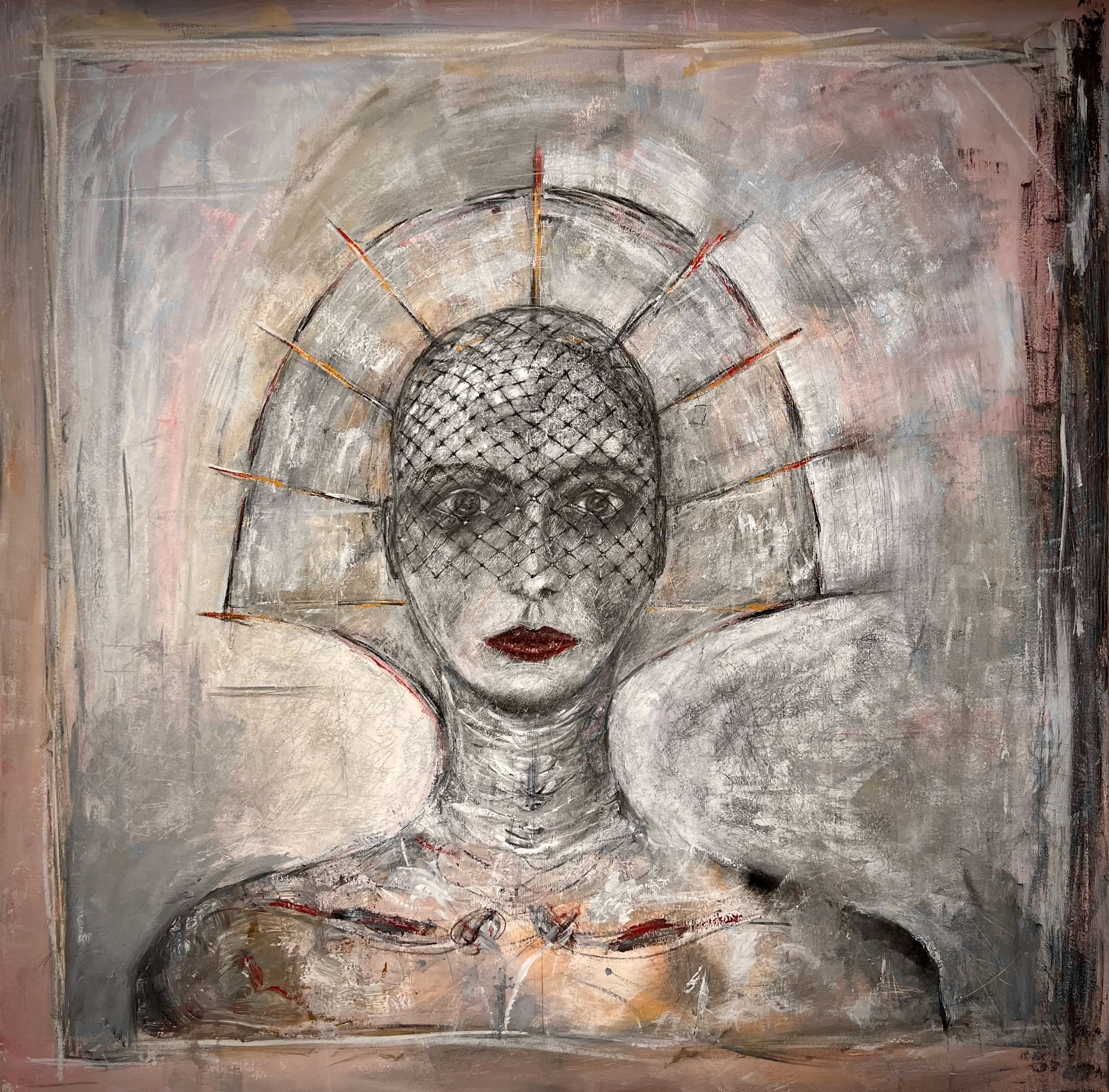
Witness Zero
Acrylic on canvass, 1000mm x 1000mm
Axis of perception — origin of the gaze — a sentinel at the threshold of becoming.
Reflection
Witness Zero emerged from an ongoing exploration of the human head as a site of attention, perception, and becoming. The figure is less a portrait than a presence held between appearance and emergence — a point at which looking, memory, and awareness seem momentarily to converge. »»
-
Witness Zero occupies an important position within a wider body of work exploring what I have come to think of as Intersentient States. Although recognisably human, the figure is not intended as a portrait of any particular individual. Instead, it serves as a focal point through which questions of attention, perception, identity, and awareness can be explored.The head emerged gradually through repeated adjustment and revision. Layers of drawing, abrasion, repainting, and partial erasure remain visible throughout the surface. Rather than describing a fixed person, the painting records a process of emergence. The image seems to assemble itself from traces, becoming progressively more present without ever becoming fully resolved.
The dark lattice crossing the face functions ambiguously. It may suggest containment, protection, mediation, memory, or distance. Equally, it may be understood simply as a visual threshold through which the viewer encounters the gaze. Behind the head, radiating arcs create a structure that recalls both a halo and a diagram, holding symbolic and analytical readings in tension.
Throughout the work, anatomical references coexist with more uncertain forms. Marks across the torso suggest vulnerability, repair, circuitry, ritual incision, or accumulated experience. The figure remains suspended between human and constructed, intimate and archetypal, wounded and resilient.
The title reflects the painting's role within the larger Witness series. The term "Zero" does not indicate absence but origin: a point before differentiation, where awareness first gathers around itself. The figure stands at a threshold between being observed and becoming capable of observation — an axis of perception from which subsequent works in the series would develop.
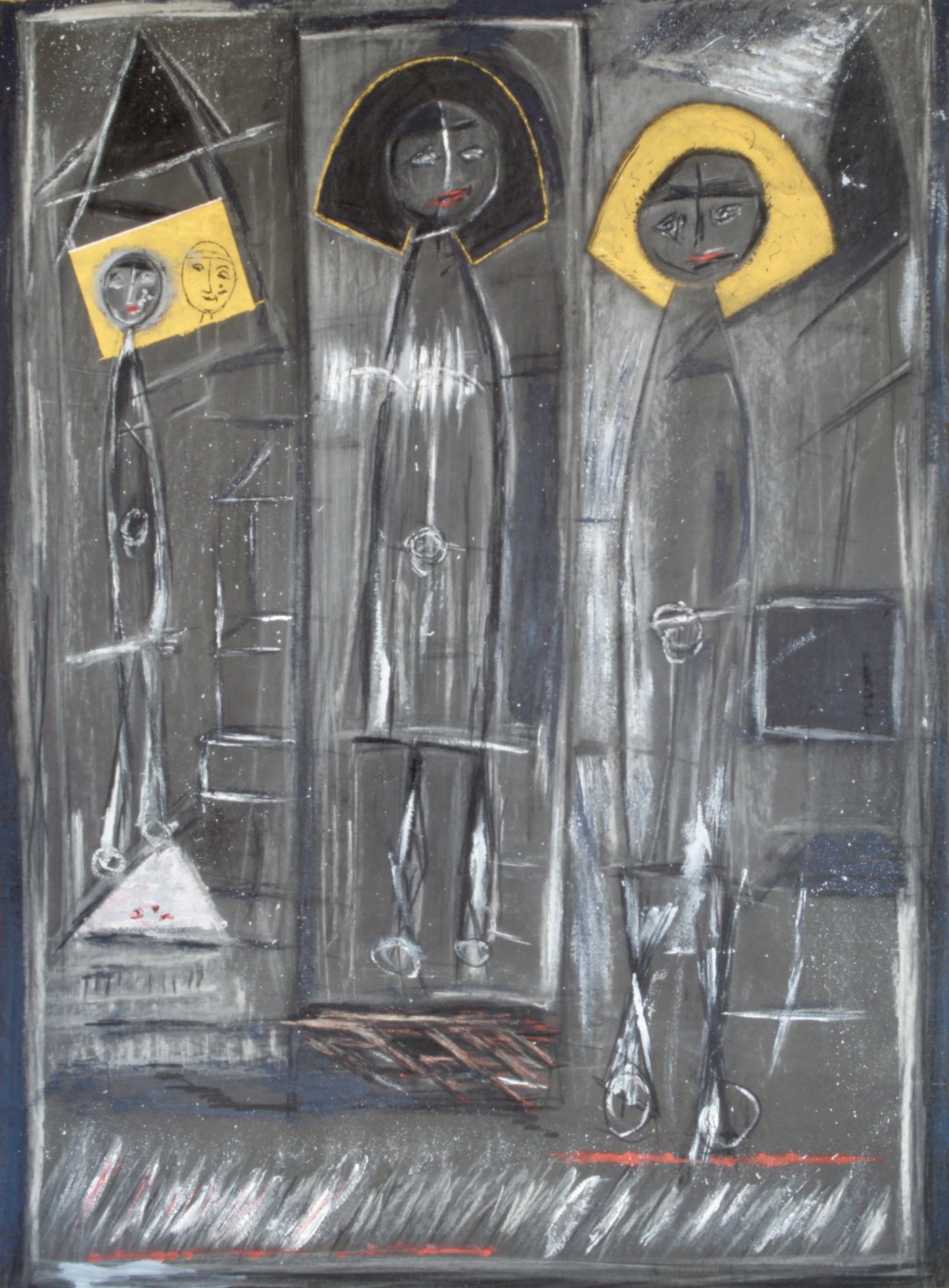
Vestibule Figures
Pencil, chalk & acrylic on paper, 810mm x 610mm
Three figures occupy a threshold space between memory, identity, and becoming. Neither portrait nor symbol, they stand as witnesses to an unfinished passage — suspended between presence and withdrawal, selfhood and reflection..
Reflection
This drawing brings together several recurring concerns within my practice: witnessing, reflection, architectural memory, and the uncertain boundary between self and image. The three figures occupy a compressed space that resembles neither interior nor exterior, but something closer to a vestibule — a place of passage, waiting, or transformation. »»
-
The central and right-hand figures stand like quiet sentinels, frontal and still, occupying vertical niches that recall alcoves, reliquaries, or institutional spaces. Their dark forms are interrupted only by small signs: red lips, circular knots, and pale marks that suggest a language not fully disclosed. They appear less as individuals than as states of attention.The smaller figure at the left introduces another theme that has become increasingly important within my work. Rather than a face, it presents a reflective plate bearing a drawn image of itself. In this moment of recursion, the figure becomes a witness to its own appearance — not a perfect mirror image, but a subtly altered echo. The self is doubled, yet remains incomplete.
This motif connects to my broader interest in what might be called a quasi-chiral self: a condition in which identity emerges through reflection but never fully coincides with itself. The image observes itself while simultaneously remaining other to itself.
The surrounding architecture contributes to this ambiguity. Ladders, doors, panels, and geometric divisions imply movement, confinement, ascent, and obstruction without resolving into narrative. They function less as objects than as psychological structures — fragments of an internal architecture through which attention moves.
Within the context of Intersentient States, the work explores the possibility that awareness may arise not within a figure alone, but within the interval between figures, symbols, and viewer. The vestibule becomes both a place and a condition: a threshold where identity, memory, and perception remain temporarily suspended.