INTERSENTIENT STATES - Material Experiments & Attentional Forms
The images below document selected works developed as part of an ongoing practice-based enquiry into what I describe as Intersentient States: conditions in which material form organises attention in a way that feels reciprocal, without attributing agency or sentience to the object itself.
It builds upon my foundational paper which can be found here. More substantive papers have been submitted in 2026 to the Journal of Visual Arts Practice [Intersentient States: An Attentional Interval] and Leonardo, [Almost Touching: The Attentional Interval as a Critical Threshold in Perception].
Rather than presenting finished outcomes, the papers trace the conditions under which attentional reciprocity begins to emerge — across vessels, sculpted heads, and surface investigations. The emphasis is on process, restraint, and residue, where form remains open enough to sustain perception.
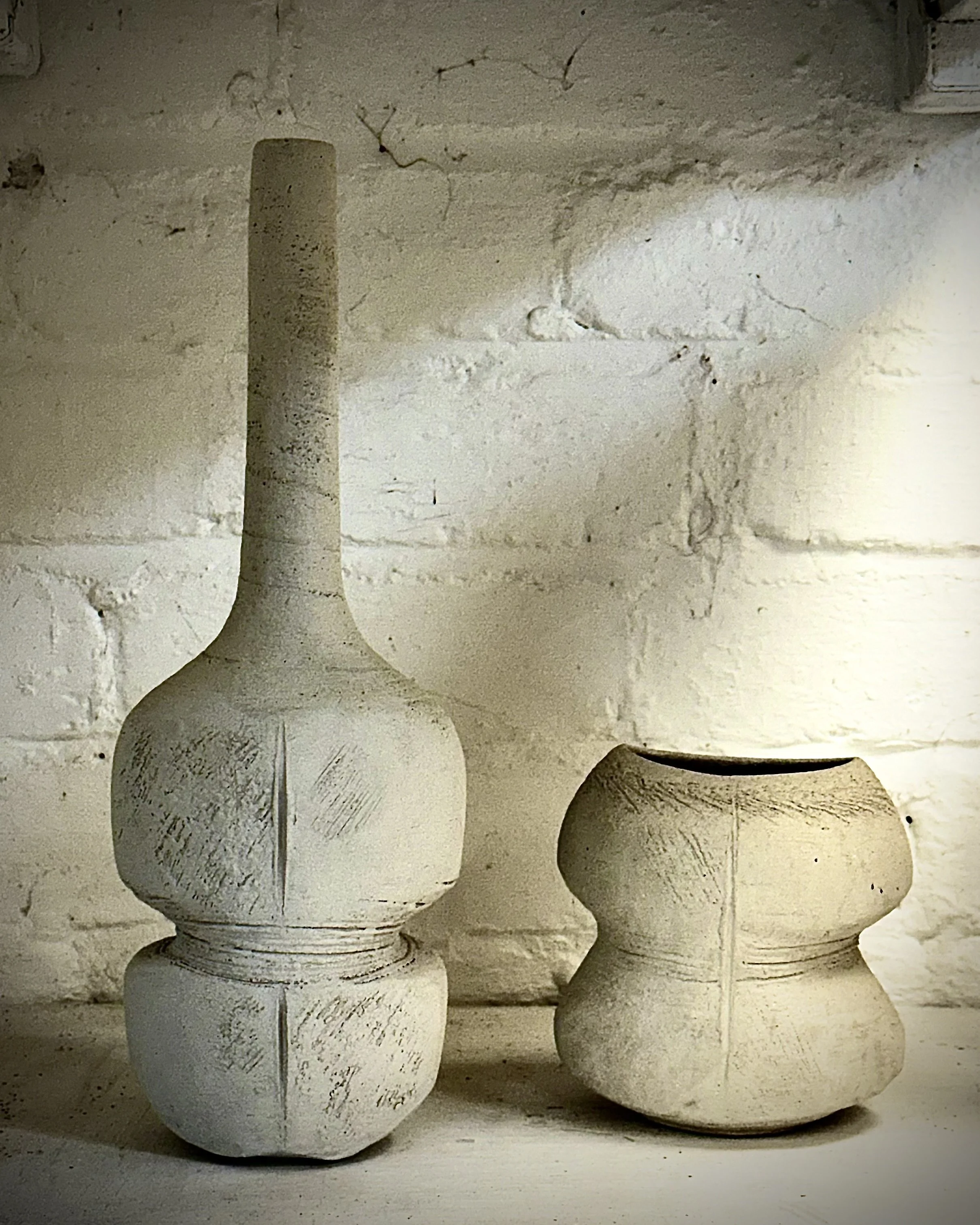
Two waisted vessels
These unfired, raw clay vessels, without surface additions, record the early stages in the development of form. Working without the finality of firing allows form to remain provisional: surfaces are still receptive, edges remain under revision, and the objects retain a sense of vulnerability. At this stage, the vessels are not yet fixed artefacts but sites of ongoing negotiation between intention, gravity, and material resistance.
The pairing is significant. Placed together, the two forms begin to establish a relational field in which attention moves not only toward each object, but between them. Their differences in height, containment, and openness generate a quiet tension that does not resolve into hierarchy or narrative. This early exploration of relational balance — neither expressive nor decorative — anticipates later concerns with how objects can hold attention through restraint rather than display.
Crucially, these works helped clarify that the condition I am interested in does not reside solely in the object, nor in the viewer, but in the encounter sustained over time. The unfired state makes this explicit: the vessels appear present yet incomplete, inviting lingering rather than interpretation. This attentional ambiguity became a foundational element in the language of Intersentient States, informing subsequent fired vessels, sculpted heads, and paintings.
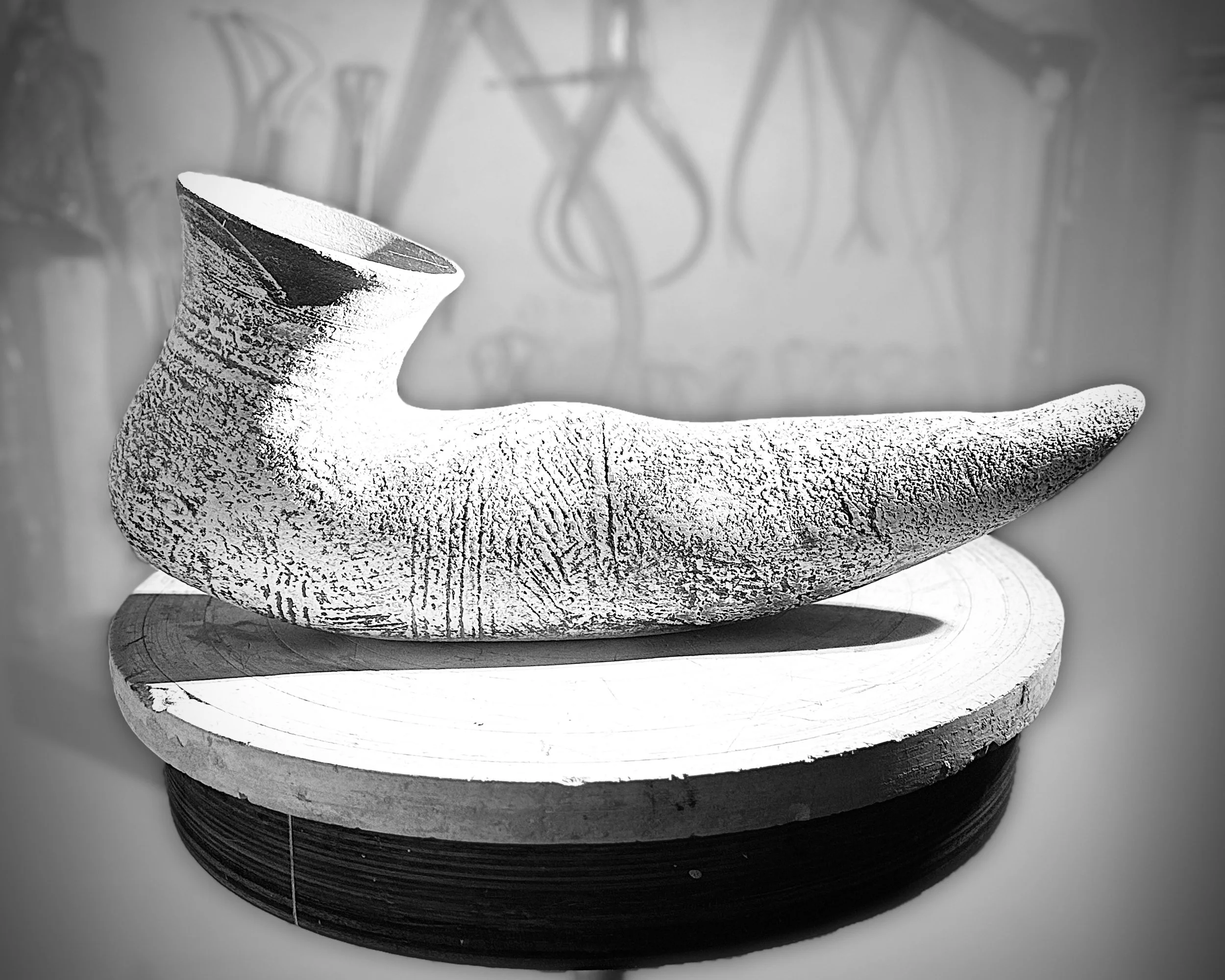
Shofar vessel
This unfired composite form brings together two separately thrown elements into a single, partially resolved body. The join is not obvious but worked repeatedly, abraided and reworked with slip and oxide so that the act of assembly remains only partially legible. Rather than presenting a finished unity, the form holds a state of provisional coherence — a body still negotiating its own alignment.
At this stage, the work operates within an intersentient condition rather than a resolved objecthood. Its surface bears the residue of repeated handling, adjustment, and pause, registering time as accumulation rather than outcome. The absence of firing suspends judgement and defers closure: what is encountered is not an image of completion, but a moment where attention is held between intention and material response, allowing perception to settle without resolution.
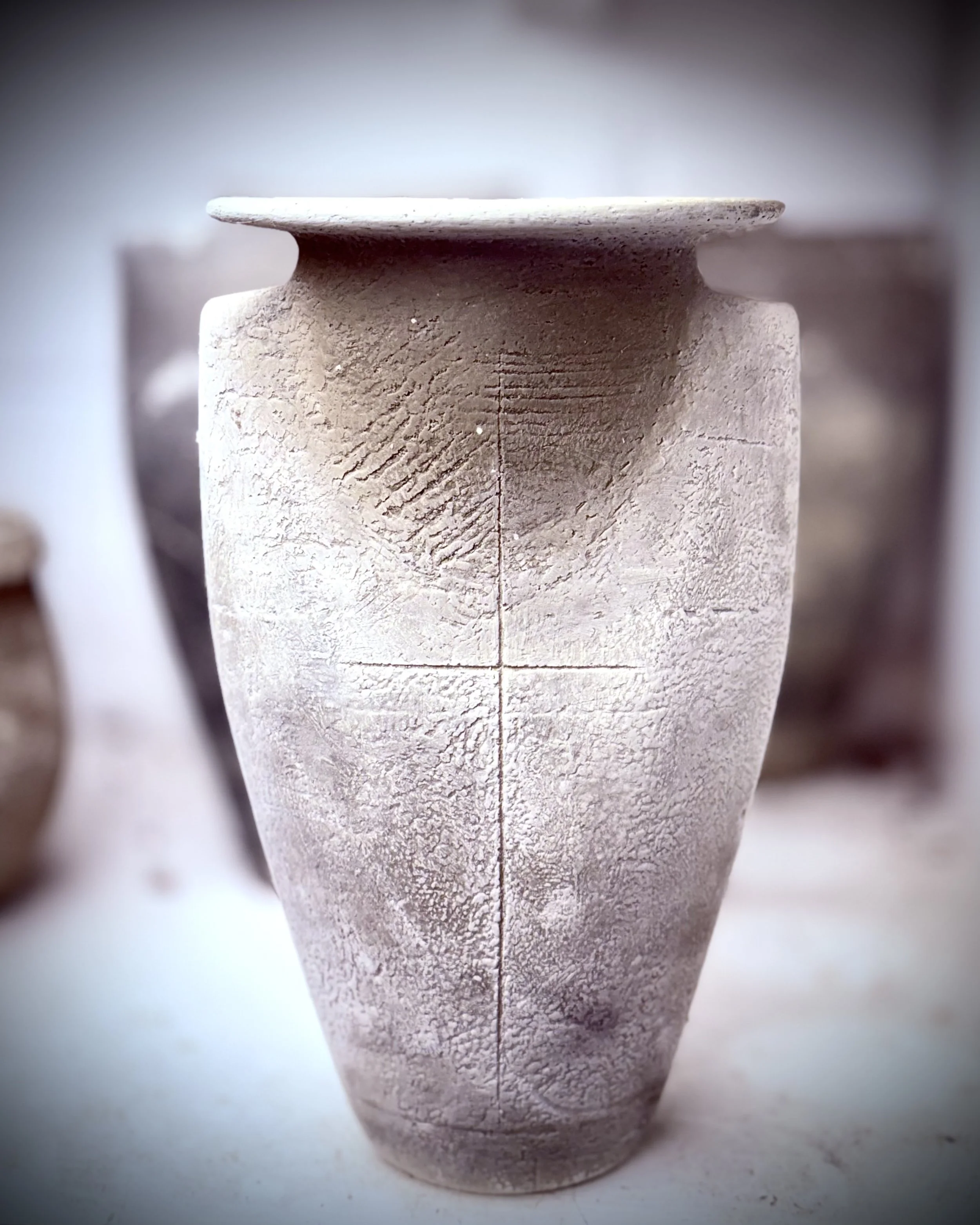
Composite vessel
This unfired vessel is constructed from four distinct elements: two thrown components combined with two hand-formed planar sections. The joins are not disguised but negotiated, with surface marks from construction partially erased, overwritten, or left exposed. No glaze, slip, or oxide has yet been applied; the surface remains materially restrained, registering touch, correction, and pause rather than finish.
The form itself is close to resolution, with only minor refinements anticipated. What remains open is the surface, which continues to operate as a site of scrutiny rather than display. Future adjustments are expected to be minimal, involving small, carefully calibrated additions of colour to a predominantly monochrome field.
In this near-resolved state, attention is held not by completion but by restraint. The unfired condition suspends closure, allowing the work to sustain an intersentient state in which form remains attentive and perception stays active, settled yet unresolved.
The cross-like incision on the frontal surface is a non-symbolic registration mark, residually retained from the re-working of the forms bilateral symmetry during alteration from its thrown origin.
The studio setting is retained to emphasise Intersentient States as a condition that emerges through making, rather than presentation.
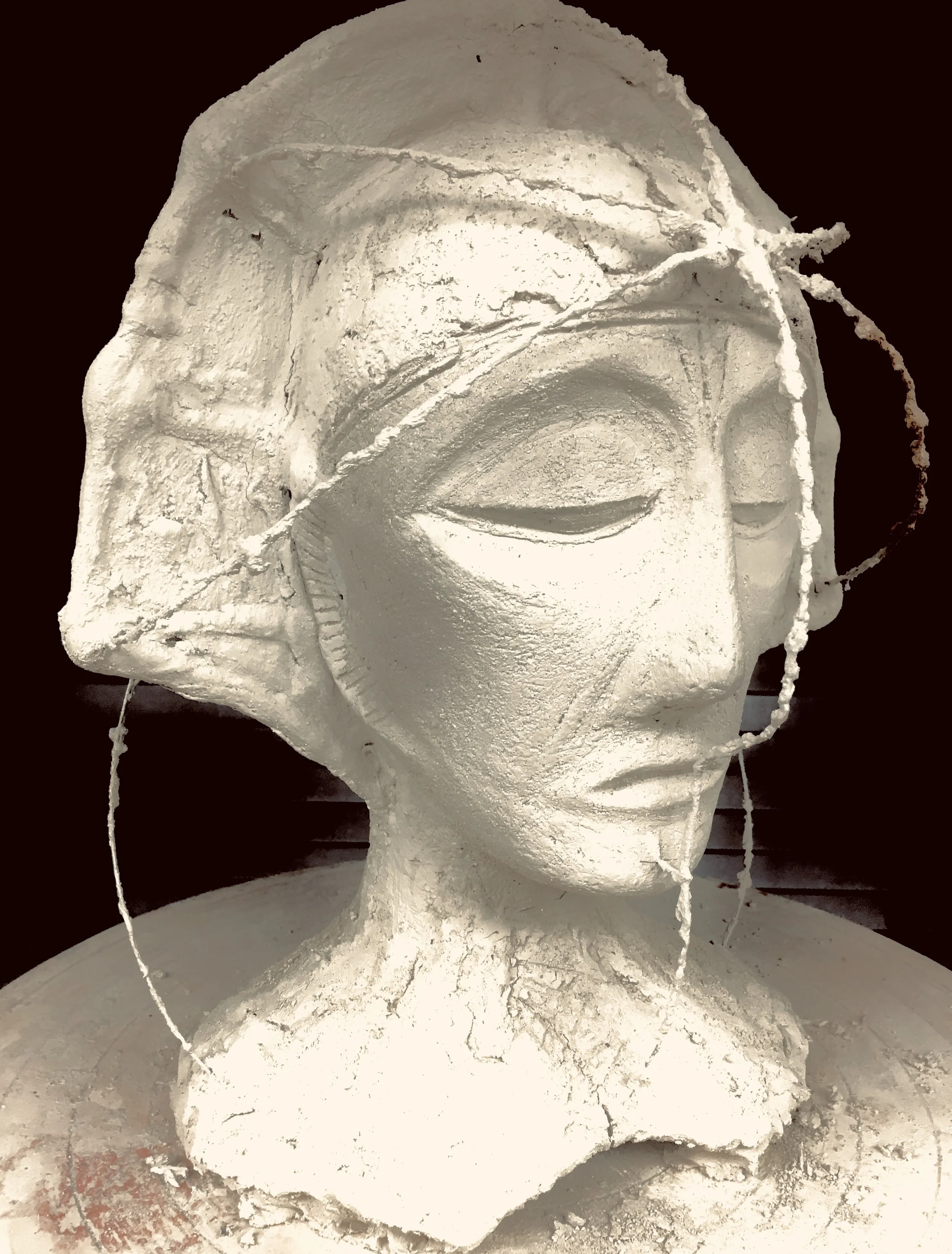
Sentinel head I
This sculpted head is shown at an advanced but unresolved stage of formation. The surface remains visibly provisional, bearing seams, interruptions, and fragile extensions that register the accumulated decisions of its making rather than concealing them. These traces are not expressive gestures but structural residues of attention, held deliberately within the form.
The head does not operate through likeness or narrative address. Its partially closed eyes, restrained modelling, and uneven contours organise perception rather than depict emotion. The form neither confronts the viewer nor withdraws, but sustains a condition of poised stillness in which attention is invited to linger without being directed towards interpretation or recognition.
This work exemplifies how Intersentient States arise through duration and restraint. The sense of reciprocity experienced by the viewer is not a projection of agency onto the object, but a consequence of how the form stabilises attention through material hesitation, vulnerability, and withheld resolution. The head appears less as a figure that speaks than as one that listens.
Shown in the studio rather than as a finished artefact, the work underscores that intersentience is cultivated through process rather than applied as an effect. Its unresolved state supports the broader research aim of examining how sculptural form can hold attention over time, grounding perception in material presence rather than immediacy or spectacle.

AI construct I
This sculpted head introduces an explicit spatial apparatus that extends the work beyond the limits of the face itself. The encircling armature does not function as a symbolic cage or illustrative device, but as a means of structuring perception in three dimensions. The viewer’s attention is compelled to move around, through, and across the form, producing an encounter that unfolds temporally rather than instantaneously.
Here, the head operates as a stabilising core within a larger perceptual field. The surrounding lines register neither movement nor narrative, but define zones of proximity and interruption that modulate how the form is apprehended. The work resists frontal resolution; no single viewpoint offers completion. Instead, perception is held in suspension, repeatedly recalibrated as the viewer shifts position.
Within the framework of Intersentient States, this work marks a transition from contained stillness toward spatial reciprocity. The sensed “regard” arises not from anthropomorphic expression, but from the way material form organises attention through restraint, obstruction, and repetition. The head appears neither passive nor expressive, but attentive — holding rather than addressing the viewer.
This work signals a trajectory toward expanding intersentient conditions beyond the object into the surrounding field. It provides a foundation for future investigations into how sculptural form, spatial extension, and material economy can collaborate to sustain attentional intervals across time, movement, and scale.
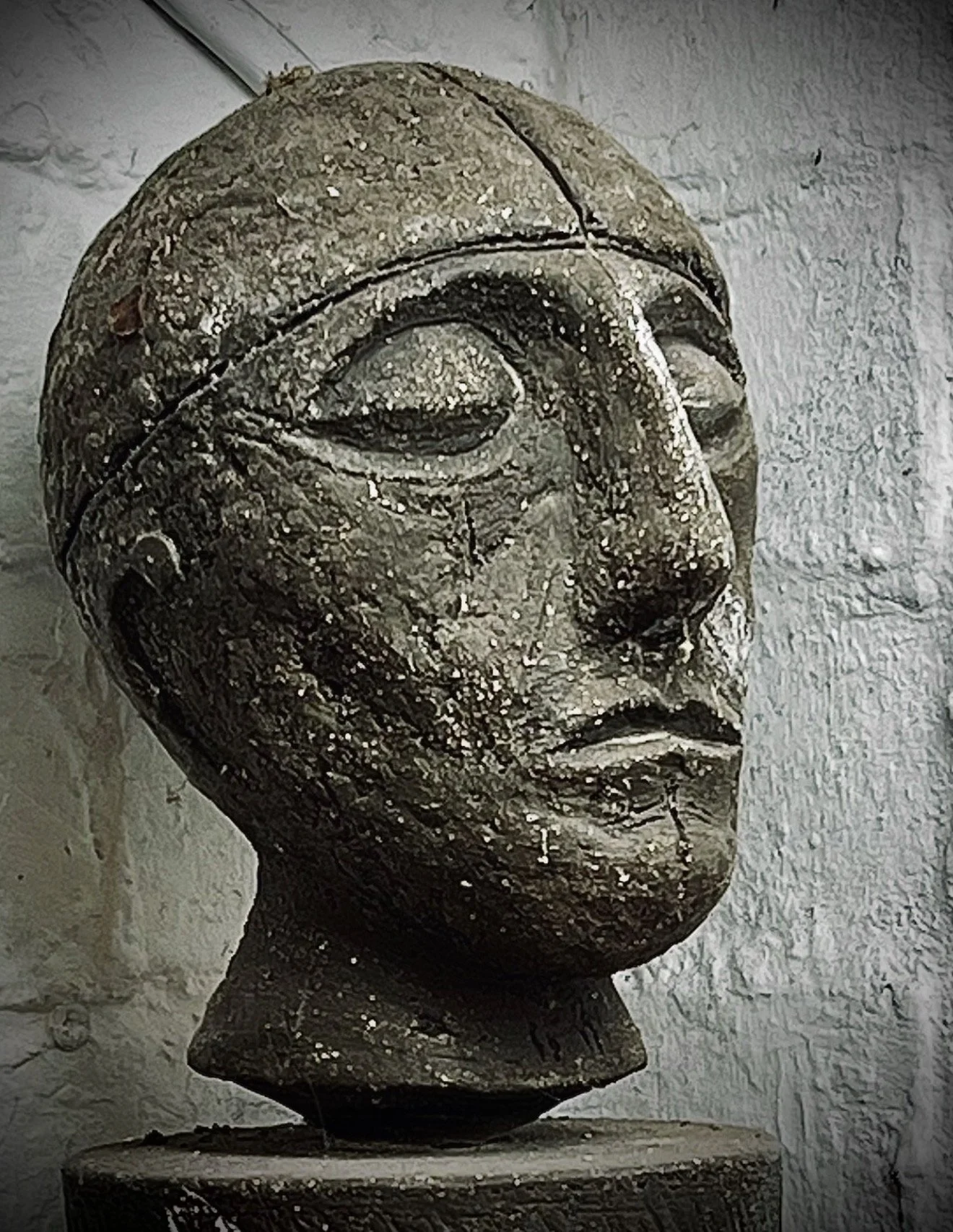
Silent custodian
This sculpted head presents a deliberately compressed and resolved form, in which features are held in a state of quiet containment. The surface retains the accumulated residue of modelling, abrasion, and adjustment, yet resists expressive disclosure. Rather than offering an image to be interpreted, the work establishes conditions under which attention may be held.
The head’s averted orientation denies frontal resolution and discourages narrative identification. Attention is directed instead toward the slow negotiation of planes, edges, and transitions, where surface marks register decision rather than gesture. The work does not invite decoding, but sustains looking through material restraint and density.
Within the framework of Intersentient States, this piece demonstrates how perceptual reciprocity can arise without overt symbolism or interaction. The sensed attentiveness emerges not through expression, but through the work’s refusal to resolve itself quickly. Attention is repeatedly returned to the surface, held in suspension rather than directed toward closure.
This work serves as a reference point for investigating how sculptural reduction and material discipline can stabilise attentional intervals. It informs research into how form, surface, and orientation collaborate to generate encounters that are durational rather than immediate, and grounded in sustained presence rather than recognition
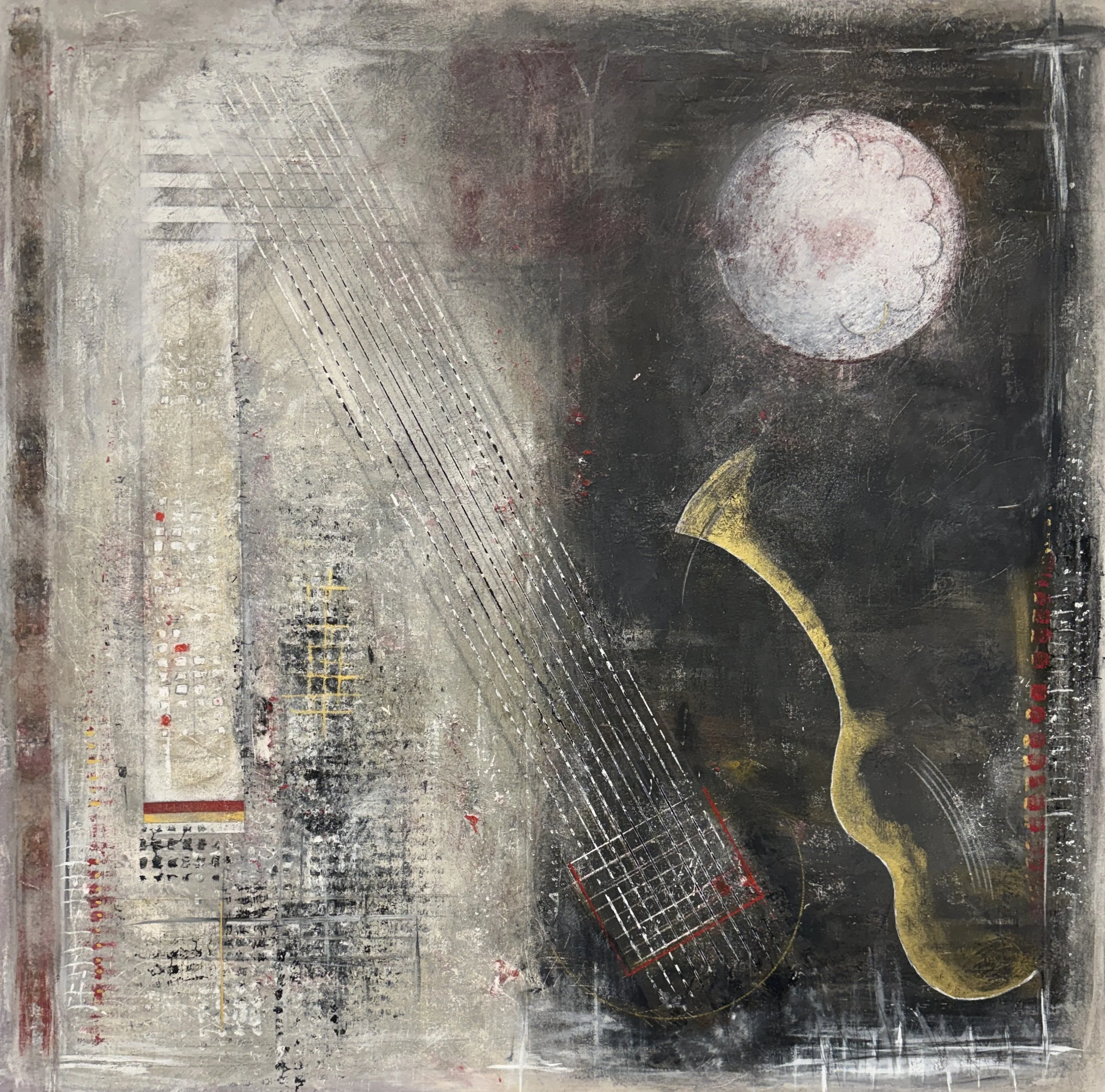
Emergent Polarity
This painting explores how attention is held not through focal imagery but through calibrated imbalance. Linear scaffolds, partial grids, and erased geometries establish a field that resists resolution, while a suspended curvilinear form interrupts any stable reading. The composition does not direct the eye so much as slow it, encouraging movement across the surface rather than toward a conclusion.
Surface here is treated as an accumulated record of decision and revision. Layers are built, partially erased, and reasserted, leaving a residue of prior states visible beneath the present configuration. These traces are not expressive gestures but evidence of duration—marks that register time spent rather than image achieved.
Colour is used sparingly and strategically. Muted grounds are punctuated by restrained tonal shifts and small inflections of warmth, which function less as emphasis than as points of perceptual tension. These elements act as thresholds, inviting attention to hover rather than settle.
Within the framework of Intersentient States, the painting operates as a perceptual interval rather than a pictorial statement. Meaning does not reside in depiction, but in the sustained negotiation between form, surface, and viewer. The work asks not to be interpreted, but to be remained with—holding attention in suspension through balance, withholding, and return
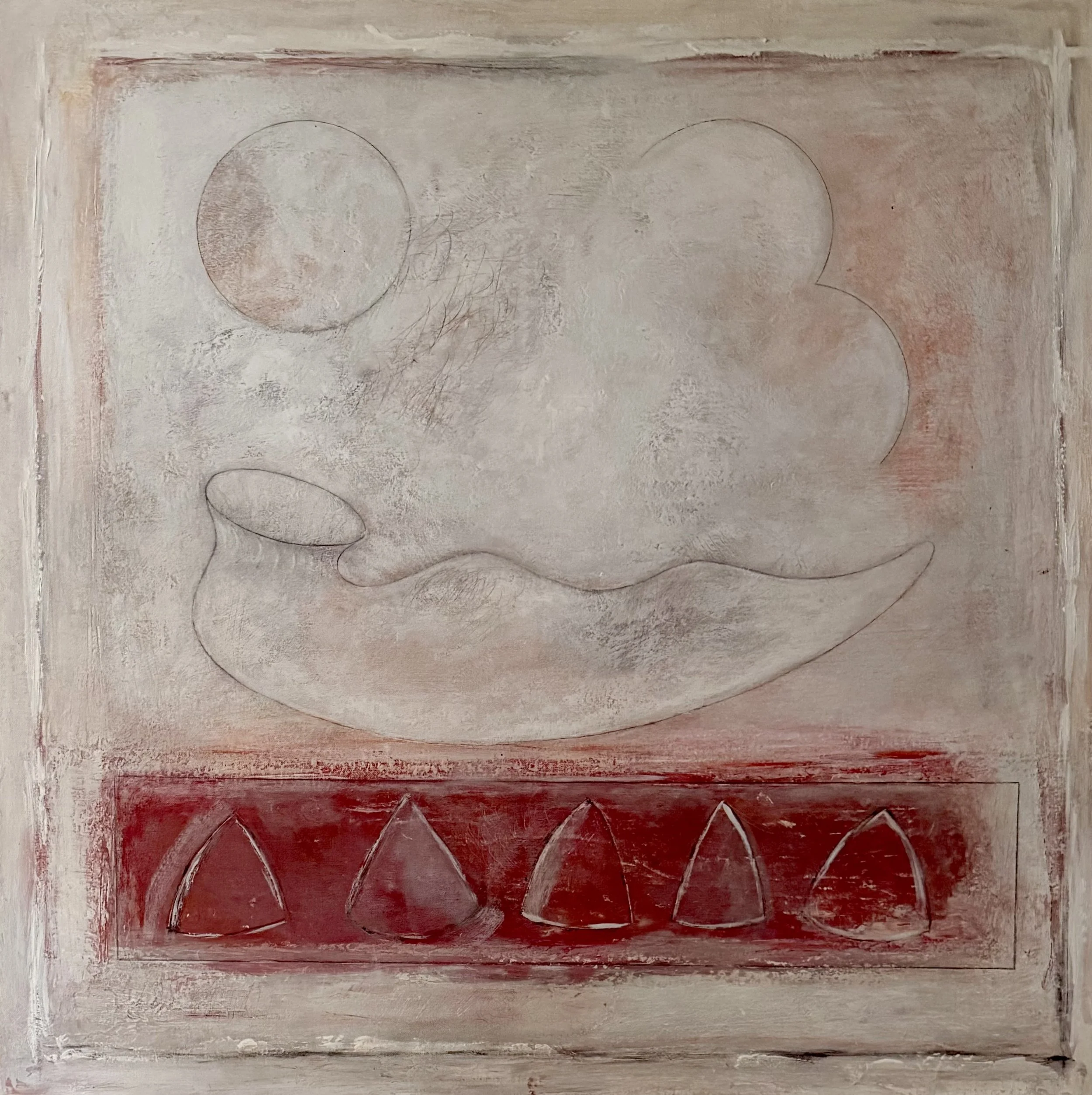
Stone Offering
This painting investigates how simple forms can sustain attention through restraint and repetition rather than complexity. Circular and curvilinear outlines are lightly inscribed into a softened field, hovering between emergence and withdrawal. The composition avoids hierarchy, allowing elements to coexist without resolving into a fixed reading.
The surface is built through repeated layering, abrasion, and partial erasure. Marks remain as faint residues rather than declarative gestures, registering a history of making that is perceptible but not foregrounded. The work carries evidence of its own revision, inviting slow visual excavation rather than immediate comprehension.
Colour is limited to a narrow, earthy register, with a dense red band anchoring the lower field. Within this band, repeated triangular forms appear as quiet markers—neither symbolic nor illustrative, but rhythmic. These repetitions introduce a temporal dimension, suggesting accumulation, passage, and measured return.
Within the context of Intersentient States, the painting functions as a sustained perceptual interval. It neither depicts nor narrates, but establishes conditions under which the viewer’s attention oscillates between surface, form, and memory. Meaning arises through duration and proximity, as the work holds the viewer in a state of attentive suspension rather than interpretive closure.
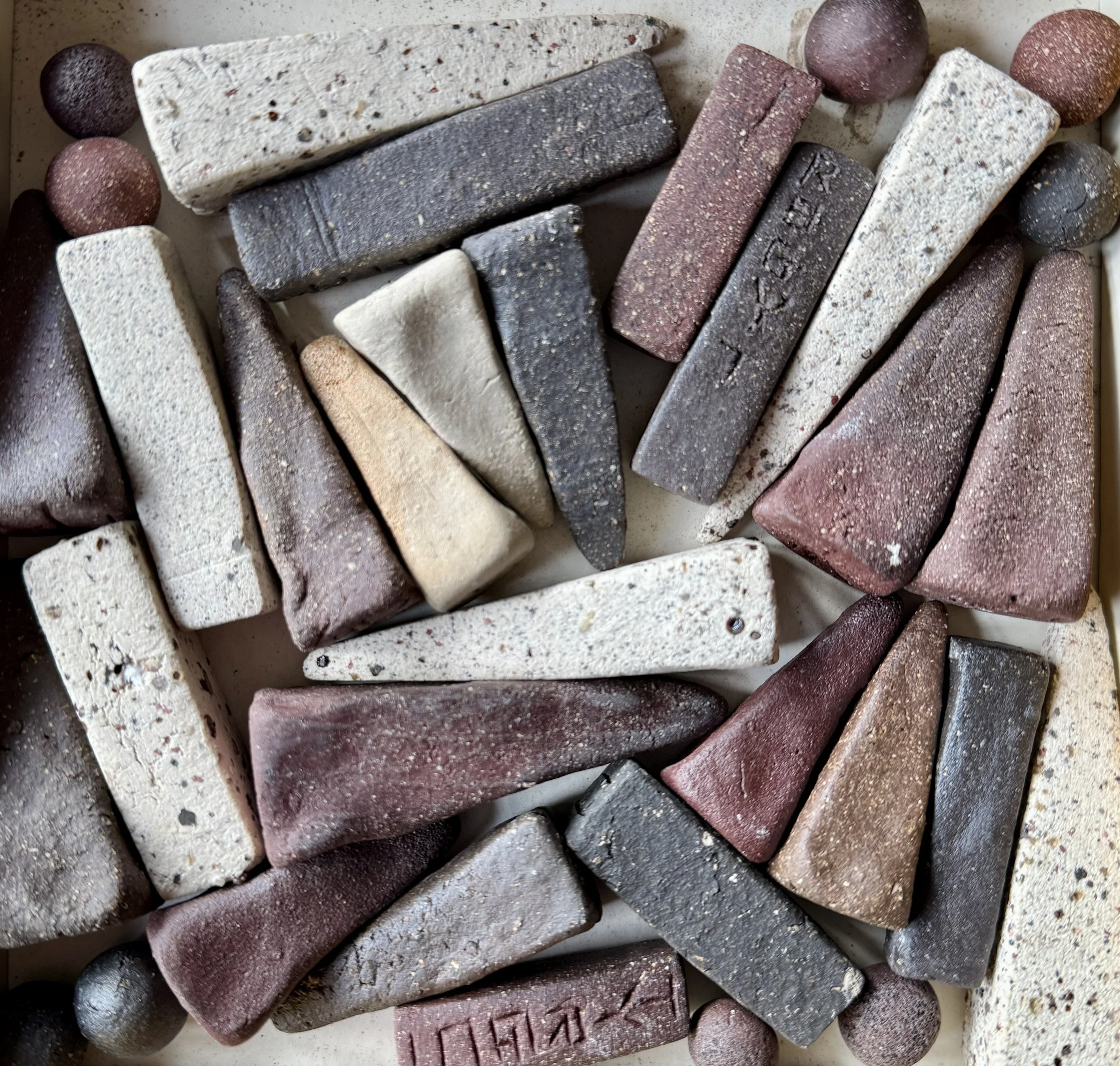
Material Tests for Perceptual Restraint
This image documents the early development of new clay bodies formed from combinations of synthetic refractory materials, naturally formed clays, and locally gathered, eroded matter, in the form of sands and grits. The aim is not novelty of composition, but the pursuit of surfaces whose texture, density, and colour arise intrinsically from the body itself.
The locally gathered clays, sands and grits have been obtained from mainly estuarine environments such as the Cleddau estuary, and various sites in Pembrokeshire and South Glamorgan UK.
Within Intersentient States, this work shifts attention away from applied surface effects toward material conditions that can hold perception without additional mediation. These tests are not outcomes but constraints: they establish limits within which form, surface, and attention must negotiate with one another.
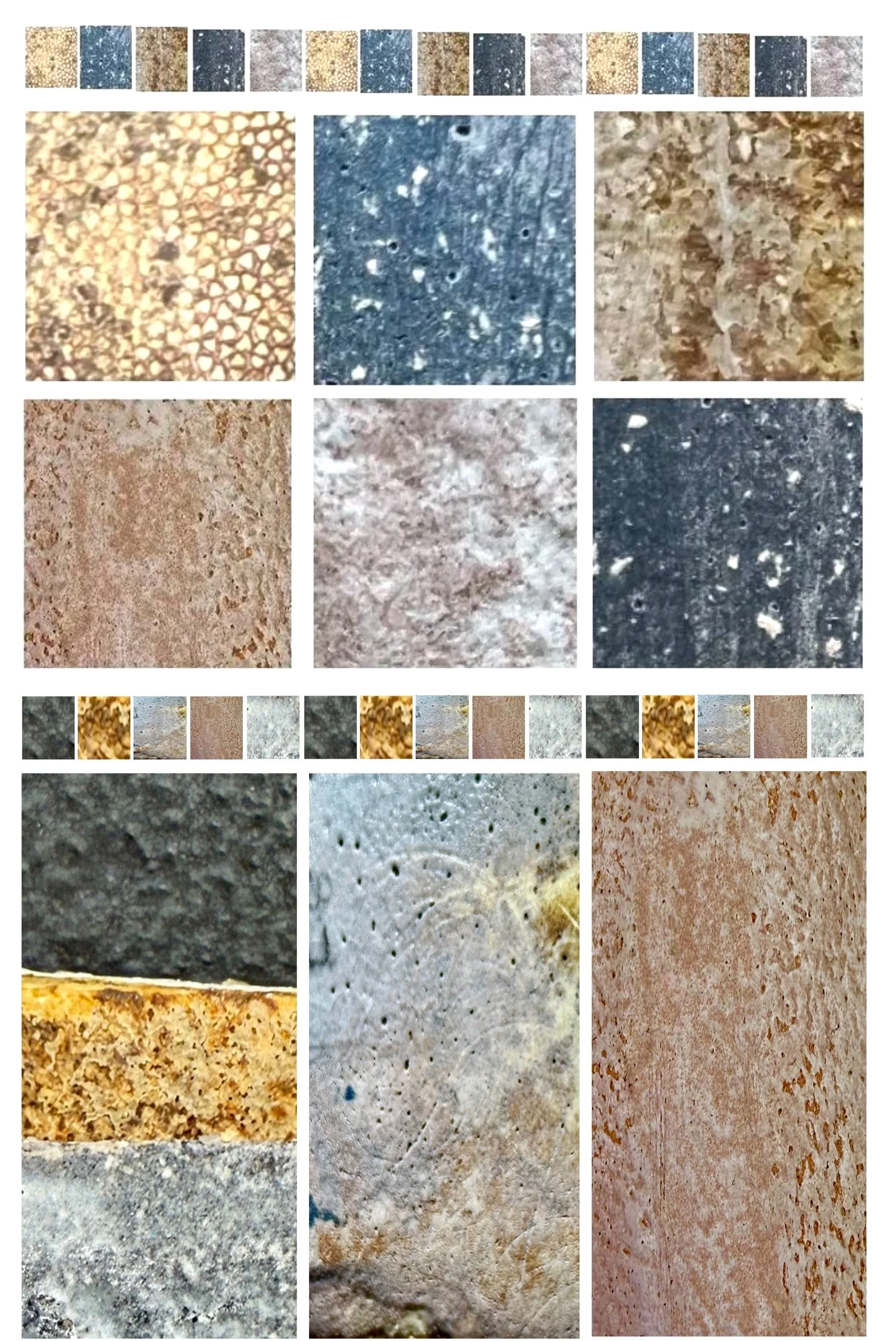
Surface Tests and Accidental Findings
This composite brings together the residue of more than forty kiln firings, drawn from an extended sequence of surface experiments undertaken over several years. The tiles document repeated trials with oxides (including iron, cobalt, and manganese), mineral inclusions such as basalt, and slips formulated from kaolin, feldspar, whiting, and molochite. The overwhelming majority of these tests failed. The surfaces shown here survived not through prediction or control, but through failure, accident, miscalculation, and patient iteration.
What is retained is not technical success, but perceptual viability. These surfaces were selected because they sustain attention without spectacle: textures that feel at once grown and made, familiar yet resistant to immediate classification. Many recall geological processes, weathered architecture, or bodily surfaces, without resolving into representation. Their appeal lies in a fragile balance between material density and visual restraint.
Within Intersentient States, this testing phase is essential. It demonstrates that attentional conditions are not designed directly, but discovered through prolonged exposure to failure, delay, and material resistance. The eventual intention is not surface richness for its own sake, but the sparse and deliberate use of such findings within otherwise restrained, predominantly monochrome vessels. Here, restraint becomes an ethical and perceptual discipline: colour and texture are introduced only where they can intensify attentiveness rather than overwhelm it.
These tests function as a reservoir of potential rather than a catalogue of effects—a collected residue of sensations from which future works may draw, sparingly and with care.
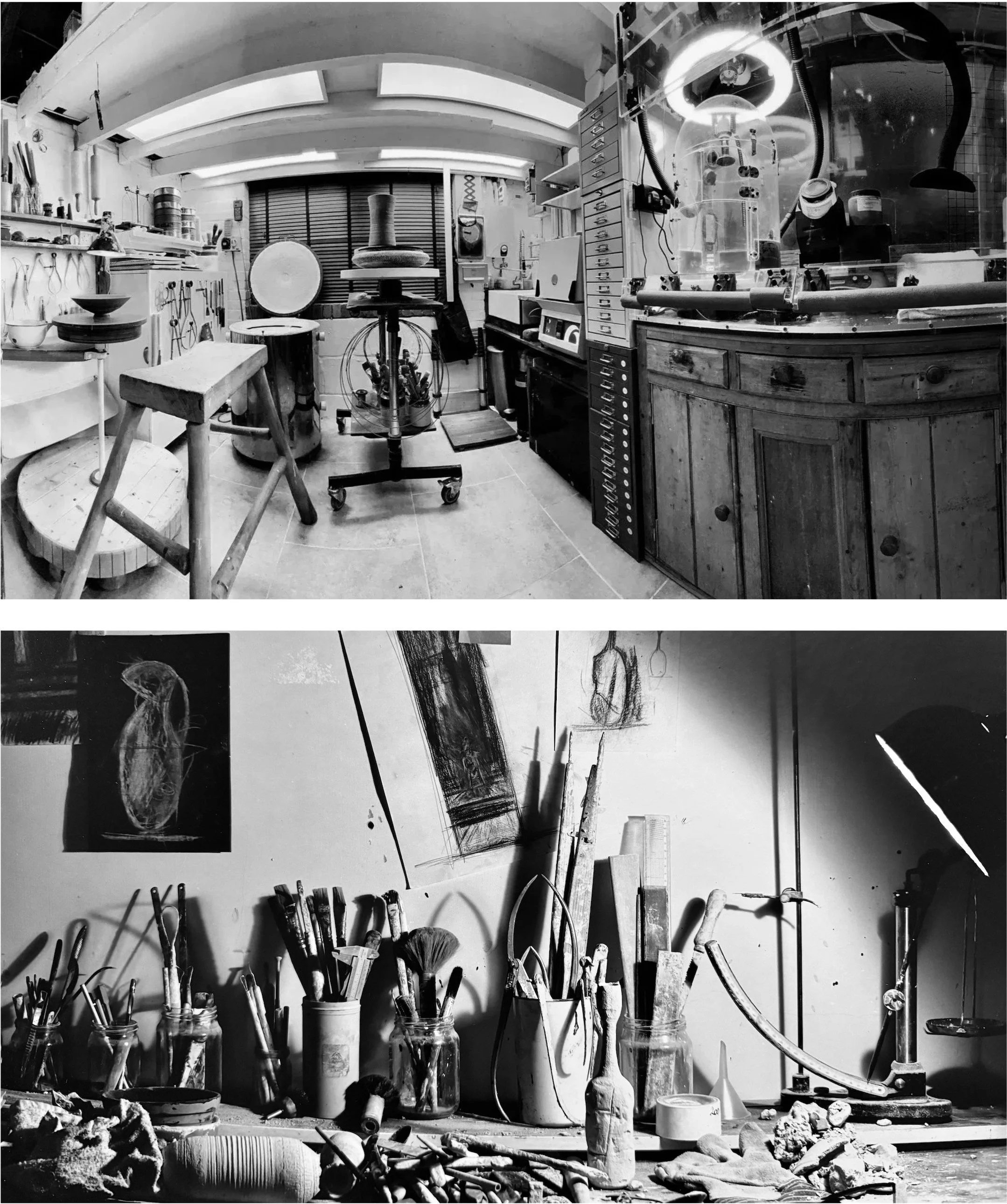
Studio
The studio is configured less as a site of production than as a controlled perceptual environment. Tools, materials, and works-in-progress are arranged to sustain slowness, repetition, and return. Nothing is optimised for efficiency. Instead, the space is structured to allow attention to circulate—between object, process, and pause—without being prematurely resolved into outcome.
This is not incidental context, but part of the apparatus through which Intersentient States are cultivated. The studio operates as a holding field in which making, adjustment, erasure, and failure remain visible and active. Works are not removed once they resist completion; they remain present, accumulating time, doubt, and revision as material facts. In this way, uncertainty is not edited out but retained as a generative condition.
The physical constraints of the studio—its scale, density, and lack of separation between tools and finished works—reinforce a continuous feedback loop between intention and material response. Decisions are made incrementally, often provisionally, and frequently undone. What emerges is not a linear progression toward resolution, but a cyclical process in which perception is repeatedly recalibrated through touch, resistance, and delay.
Within this environment, attention is trained rather than directed. The studio becomes a place where perceptual habits are slowed and redistributed, allowing works to be encountered not as images to be read, but as forms that hold attention over time. In this sense, the studio itself functions as an intersentient structure: a space designed to suspend closure, sustain inquiry, and allow meaning to arise through prolonged engagement rather than assertion.
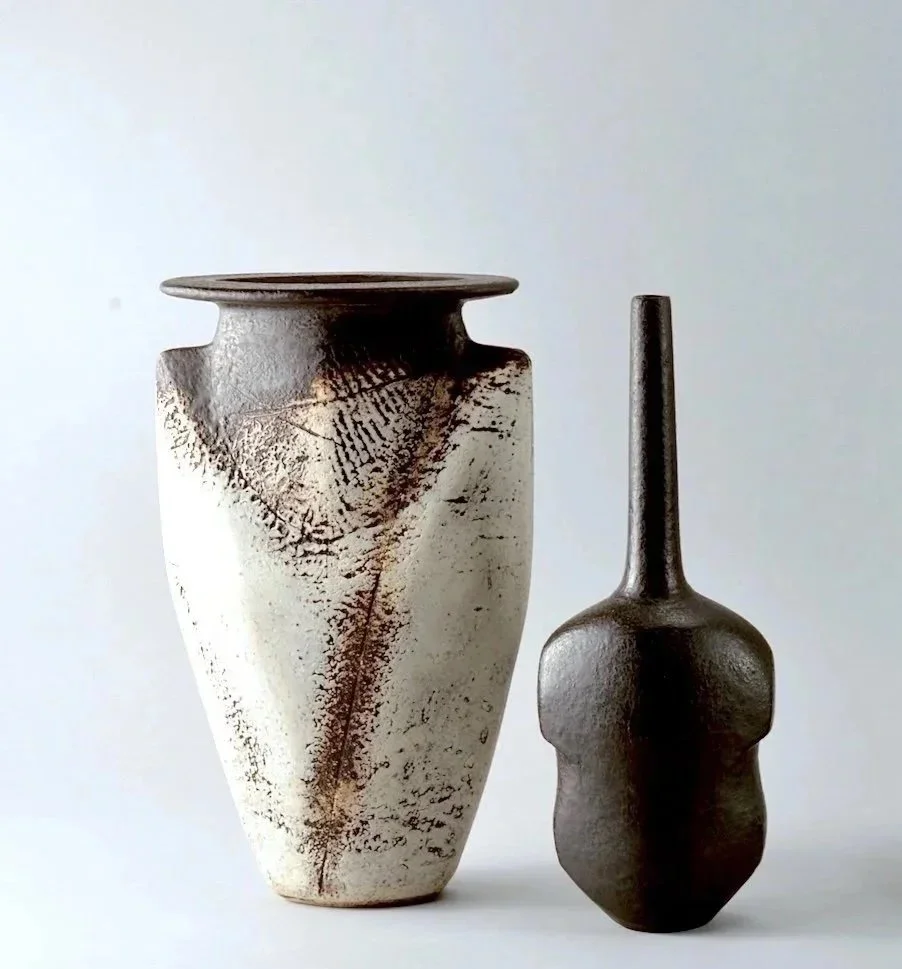
Choral vessel pairing
This paired work represents the most resolved articulation to date of the questions explored throughout this investigation. While developed independently, the two forms are presented together because their meaning arises relationally, through proximity, scale, and mutual orientation rather than through any single object considered in isolation.
The vessels do not operate as a set in a decorative or typological sense. Instead, they establish a shared field of attention in which surface, volume, and interval are held in balance. The space between them becomes active, inviting a sustained mode of looking in which the viewer’s awareness oscillates between forms rather than settling on either.
Material restraint is central to this pairing. Surface treatments are limited and deliberately non-demonstrative, allowing form, proportion, and tonal modulation to carry the work. This restraint reflects an ongoing interest in how objects may remain open to scrutiny without resorting to overt expressiveness or narrative closure.
This pair serves as a current point of convergence rather than a final outcome. It offers a provisional but coherent indication of how the notion of Intersentient States might be materially realised, while leaving space for further refinement, variation, and theoretical articulation within a monograph under preparation.